
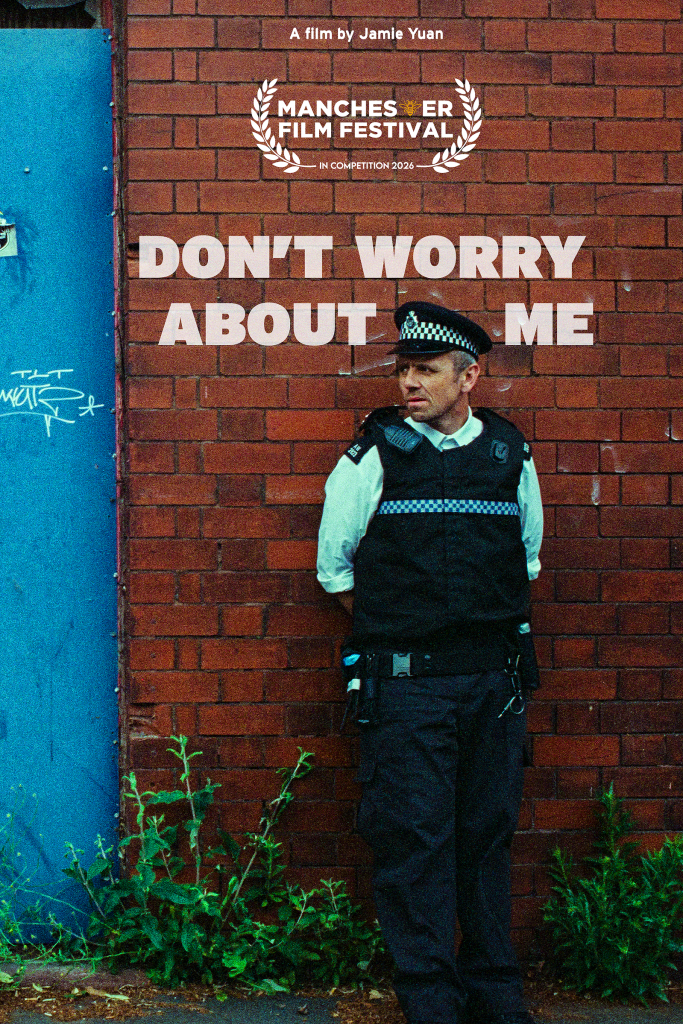
The makers of Don’t Worry About Me made something rare: a film where restraint is a philosophy, not just a workaround. Here’s what the industry can learn from it.
There’s a particular kind of courage in making a film about things that actually happened to you — and then deliberately fictionalising them anyway. Steven Louis Arnold, the writer behind Don’t Worry About Me, had every reason to make a raw, confessional piece drawing on his police experience. Instead, he made something more interesting: a film shaped by emotional truth rather than biographical fact.
“The things I dealt with in the police they’re not just my stories, there are victims involved,” Arnold explains. “So it was about taking the emotional truth of those moments and reshaping them.” That instinct — to protect, to fictionalise, to find the universal in the specific — is precisely what separates serious filmmaking from self-expression dressed up as cinema. “Writing, for me, is the best form of therapy. It lets you process things and re-evaluate them from a slightly more detached perspective.“
Director Jamie Yuan came to the project as a viewer first. What drew him wasn’t the subject matter but the architecture: two characters, one contained setting, layered beneath. “You can tell when something is written by someone who’s lived it,” he says. “That gives the script a depth and quality you can’t really fake.“
The difference between a sketch and a short film is intent
One of the more useful distinctions to emerge from the film’s development is the question of what a short film actually is. Yuan’s answer is blunt: a sketch is a setup leading to a punchline. A short film makes you think beyond the immediate moment. “Sometimes you watch shorts and feel like they could have been two minutes instead of ten. They’re just extended gags.“
Arnold sharpens this further. “When it stops being about the punchline and becomes about character, that’s when it shifts.” It sounds obvious, but the number of festival shorts that mistake mood for meaning suggests otherwise. The distinction matters because it determines every decision that follows — casting, pacing, edit choices, even where to put the humour.
And there is humour in Don’t Worry About Me. Arnold is deliberate about this. “You don’t want it to be all doom and gloom. There’s always a bit of humour in real life, even in difficult situations.” That tonal balance — holding difficulty and lightness simultaneously — is one of the hardest things to achieve in short form, and one of the clearest signs of a writer who understands story structure rather than just subject matter.
“The best films balance everything: they entertain, but there’s also something deeper there if you want to engage with it.“— Steven Louis Arnold, Writer
Casting was treated as the film’s most critical decision. Yuan ran self-tapes via Spotlight, selecting scenes that required genuine emotional depth rather than surface performance. “I spoke to them about their interpretation — I actually find that more useful than traditional auditions.” The lead actors, Keeley and William, already knew each other — a coincidence that paid dividends in their on-screen chemistry.
The edit isn’t post-production — it’s part of the writing
Yuan edited the film himself, him background making this a natural fit. But he’s candid about the risk: “You can get too close to the material.” The solution was collaboration — being willing to cut things that worked as individual moments but didn’t serve the whole. Some of the film’s most effective choices weren’t in the original script. The opening, for instance, emerged in the edit. “It works better visually,” Arnold notes. “It’s a good example of how writing and directing complement each other.“
This is the version of filmmaking that rarely gets discussed in coverage of low-budget production — not the heroism of making something with nothing, but the discipline of knowing what to remove. Restraint isn’t a limitation here. It’s the methodology.
“You’re not doing shorts for money. You’re doing them to develop your craft, build relationships, and create opportunities. That’s the real value.”— Jamie Yuan, Director
For Arnold, the film sits within a broader strategic approach to the industry — features, shorts, theatre, development. “It’s about momentum — seeing what connects first.” There’s a feature version of the script. There are other projects in progress, including one designed to be commercially viable. The short film is both a standalone work and a proof of concept, which is perhaps the most honest thing you can say about independent short filmmaking now.
Don’t Worry About Me is, in the end, a film that knows exactly what it is. That clarity — of vision, of intent, of what to leave out — is rarer than any production budget can buy.
Written by Susanda Wolf